Red Sandalwood Plantation in Andhra Pradesh: What Buyers Should Know Before Choosing Farmland
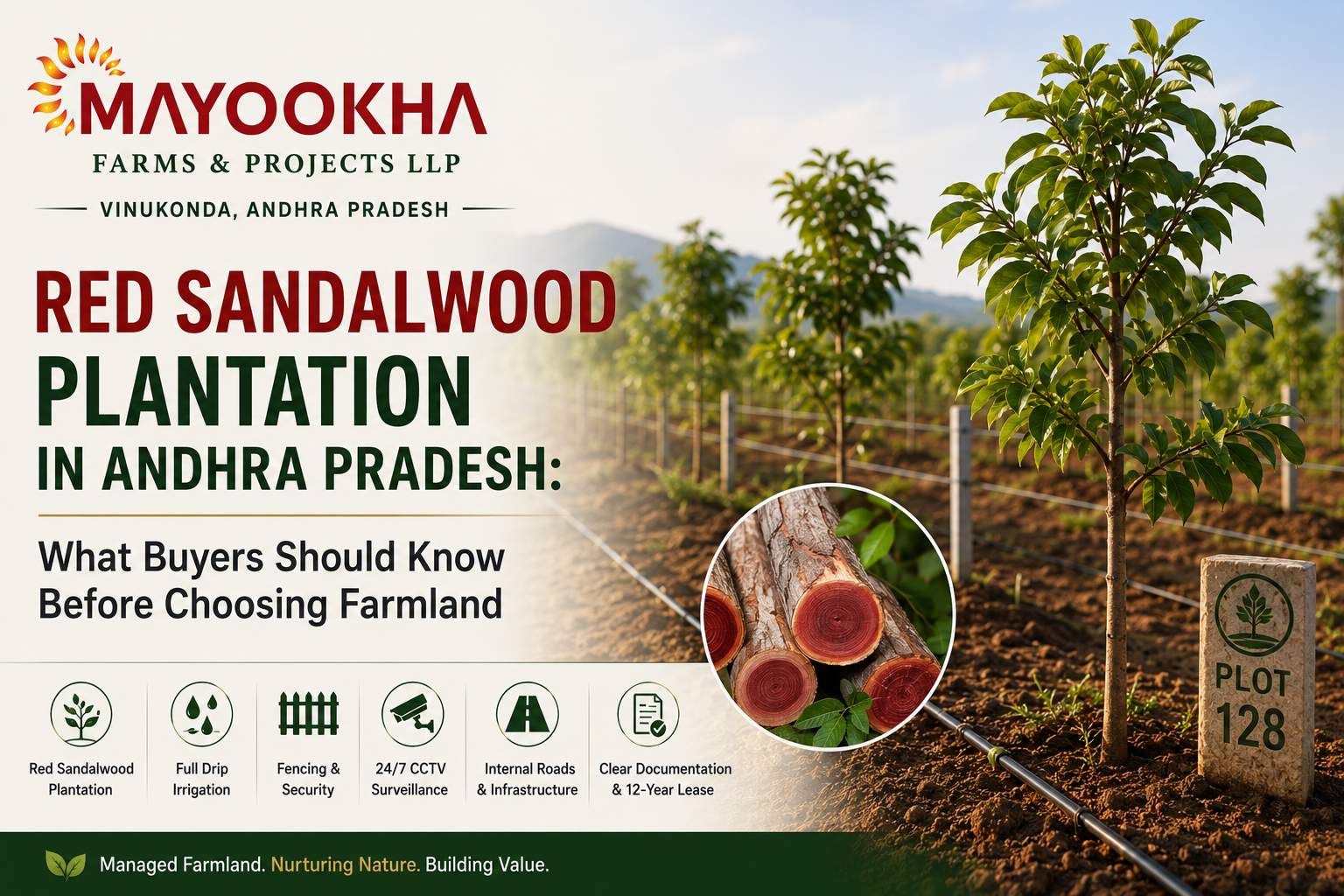
A farmland project can look attractive because of its location, road access or price. But when red sandalwood plantation is part of the plan, there is another layer to understand. How are the trees maintained? What kind of irrigation is required? Who takes care of the plantation after the land is purchased? And what should a buyer know about the regulations surrounding red sandalwood? These questions are worth asking before purchasing a plantation-based farmland plot.
Red sandalwood plantation in Andhra Pradesh has attracted attention because the species is native to parts of southern India and is associated with valuable timber. At the same time, red sandalwood is a regulated forest produce, which means cultivation and eventual movement or harvesting need to be understood within the applicable rules.
For buyers considering managed farmland, the plantation itself should therefore be looked at alongside the land, documentation, infrastructure and management arrangement.
Why is red sandalwood cultivated in Andhra Pradesh?
Red sandalwood, scientifically known as Pterocarpus santalinus, is native to the southern Eastern Ghats region of India. The tree is valued for its distinctive red heartwood and has a long history of use in furniture, carving, cultural products and other applications.
The species is also known as red sanders or Yerra Chandanam.
Its scarcity and the characteristics of its timber have contributed to its commercial interest. However, that does not mean that every red sandalwood plantation automatically produces a particular financial outcome.
Growth, tree quality, plantation management, market conditions, harvesting eligibility and regulatory requirements all matter.
This is why responsible plantation projects should focus on the process of cultivation and management, rather than making short-term return promises.
What does a managed red sandalwood plantation involve?
Planting trees is only the beginning.
A plantation needs regular attention, particularly during the early stages of growth. Water management, protection from damage, monitoring, maintenance and general farm management all contribute to the condition of the plantation.
A managed farmland model attempts to bring these activities under a coordinated system. Mayookha Farms & Projects describes its broader approach as sustainable agroforestry, combining tree cultivation with agricultural land management and modern farming practices. The company says its project development process includes soil testing, plantation management and dedicated workers and supervisors.
For a landowner, this can be particularly relevant when regular personal visits to the property are difficult.
Why is drip irrigation important for a plantation?
Water management is one of the practical considerations in any plantation. Traditional methods of watering can require significant labour and may not distribute water evenly. A drip irrigation system delivers water closer to the root zone, allowing the plantation to be managed in a more controlled manner. The Mayookha Vinukonda Farmlands project includes a full drip irrigation system for red sandalwood plantation as one of its project features.
The objective is straightforward: provide a planned irrigation arrangement while the plantation is being maintained.
Of course, irrigation alone does not determine how trees will grow. Soil conditions, climate, plant health, maintenance and other factors also play a role.
Protection matters too
Young plantation trees need protection.
Animals, accidental damage, unauthorised access and other physical risks can affect a developing plantation. This is why fencing and monitoring are practical features rather than simply decorative additions to a farmland project.
The Mayookha Vinukonda Farmlands project includes:
- Complete diamond wire fencing around the venture
- 24/7 CCTV surveillance and monitoring
- A grand entrance main gate
- Cement plot number boards
- Internal road development
These features are intended to create a structured environment around the farmland and plantation.
For a buyer, it is worth checking the actual condition of these facilities during a site visit rather than relying only on photographs or promotional material.
Red sandalwood is not an ordinary timber crop
This is one point prospective buyers should understand clearly.
Red sandalwood is subject to specific regulatory controls in Andhra Pradesh.
The Andhra Pradesh Forest Department's guidelines state that extraction and transit of red sanders from private patta land are regulated under the applicable laws and rules. The procedures include matters such as property-mark registration, tree verification, departmental inspection, permission for extraction and transit documentation.
The Andhra Pradesh Forest Act also contains provisions relating to privately held red sanders wood and the documentation required for its transport.
So a plantation should never be marketed on the assumption that a landowner can simply cut the trees and transport the timber whenever they choose. The applicable rules and permissions matter. That is actually an important question to ask any company offering red sandalwood farmland.
What should a buyer ask about red sandalwood plantation?
Before purchasing a plantation-based farmland plot, ask specific questions rather than relying on broad promises.
For example:
1. Who is responsible for plantation maintenance?
Understand whether maintenance is handled by the project company, the landowner or another arrangement.
What irrigation system is provided?
Ask whether drip irrigation is already installed, planned or included as part of the project.
2. How are the trees monitored?
Find out how plantation progress and tree health are tracked.
3. What happens if a tree does not survive?
The agreement should make responsibilities clear instead of leaving assumptions.
4. What are the terms relating to future harvesting and profit sharing?
This is particularly important when the project includes a commercial sharing arrangement.
These questions help turn a general investment pitch into something that can actually be evaluated.
Mayookha Vinukonda Farmlands and red sandalwood plantation
The current Mayookha Vinukonda Farmlands project is positioned as a managed farmland development with red sandalwood plantation as a central part of the project.
The project offers multiple plot sizes:
5 Guntas
605 sq. yards | 12.5 cents | ₹5,00,000
10 Guntas
1,210 sq. yards | 25 cents | 1/4 acre | ₹9,00,000
20 Guntas
2,420 sq. yards | 50 cents | 1/2 acre | ₹18,00,000
40 Guntas
4,840 sq. yards | 100 cents | 1 acre | ₹36,00,000
The current project terms provided by Mayookha also include a 60:40 red sandalwood profit-sharing arrangement, with 60% allocated to the customer and 40% to the company.
As with any contractual arrangement, prospective buyers should review the exact agreement and understand how the profit-sharing calculation works before proceeding.
What else is included in the Vinukonda project?
The plantation is only one part of the development. The current project specifications include:
1. Portable iron cabin: A site farmhouse facility is planned as part of the project.
2. Road network: The project includes a 30-foot main road along with 20-foot and 16-foot internal roads.
3. Fencing: Complete diamond wire fencing is planned around the venture.
4. Security: CCTV surveillance and monitoring are provided as part of the project features.
5. Plot identification: Cement plot number name boards are provided for individual plots.
These facilities can make a difference to someone who wants to own farmland but does not intend to personally manage every aspect of the property.
Location is another part of the decision
The project is located in Vinukonda, Andhra Pradesh. According to the current project information provided by Mayookha, the farmland is positioned around 4 km from the Srisailam Highway and about 12 km from Vinukonda municipality. The project is also being positioned in relation to proposed and developing infrastructure in the wider region, including Amaravati and the Donakonda industrial corridor. There is also a broader connectivity story around Vinukonda.
The Ministry of Road Transport and Highways has proposed the upgradation of the NH-544D Vinukonda-Guntur section toward the Amaravati Outer Ring Road. The proposed corridor is intended to improve connectivity between the wider Guntur region and the Amaravati side of the network.
This does not mean that nearby farmland prices will automatically rise.
Infrastructure development can improve accessibility and regional connectivity, but land appreciation depends on many factors and should never be presented as guaranteed.
What about Amaravati?
Amaravati is undergoing continued planning and infrastructure development through the Andhra Pradesh Capital Region Development Authority.
Current APCRDA procurement notices include infrastructure works in several villages within the Amaravati Capital City area, while other current notices cover development and quality-assurance activities connected with the capital city.
For farmland buyers looking at the wider region, this makes connectivity to the Amaravati area an interesting factor to consider.
But there is an important distinction.
Vinukonda is not Amaravati.
A farmland project in Vinukonda should be evaluated as a Vinukonda property, while its connectivity to larger regional centres can be considered as one of the surrounding location factors.
That is a more sensible way to look at the opportunity.
Is red sandalwood farmland suitable for everyone?
Not necessarily. A plantation-based farmland project is generally more suitable for someone who is comfortable with a longer-term ownership approach and understands that agricultural and timber assets do not behave like short-term financial products. Someone looking for guaranteed short-term returns should be particularly cautious about any investment that makes such promises.
A buyer should consider:
- How long they are willing to hold the land
- Whether they understand the plantation model
- The terms of the ownership and agreement
- Maintenance responsibilities
- Applicable regulations
- The risks associated with agricultural and timber markets
- Their own financial situation
The decision should be based on the complete project rather than the red sandalwood story alone.
What makes a managed plantation different from buying vacant farmland?
This is perhaps the biggest practical difference. With vacant agricultural land, the owner may need to arrange plantation development, irrigation, fencing, security and ongoing maintenance independently.
With a managed project, these elements can be coordinated by the project developer according to the agreed terms.
Mayookha Farms & Projects positions its model around this combination of land development, plantation cultivation and ongoing project management. The company says its approach includes modern agricultural equipment, soil testing, dedicated workers and project management.
For buyers who live away from the farm location, that management component may be an important consideration.
Still, the agreement should always be read carefully to understand exactly what is included.
A sensible way to evaluate a red sandalwood farmland project
If you are considering red sandalwood plantation in Andhra Pradesh, start with the basics.
Visit the land.
Understand the location.
Review the ownership and registration documents.
Ask about the plantation plan.
Understand irrigation and maintenance.
Check the fencing and security arrangements.
Ask how the red sandalwood profit-sharing arrangement works, if applicable.
And understand the regulatory requirements surrounding eventual harvesting and transportation.
A good farmland purchase should make sense even after you remove the excitement surrounding future returns.
That is the better test.
Why Mayookha's Vinukonda project takes a managed approach
Mayookha Farms & Projects combines farmland development with red sandalwood plantation and supporting infrastructure at its Vinukonda project.
The current project includes multiple plot sizes, drip irrigation, fencing, CCTV monitoring, roads, plantation management and other site facilities. The company also states that registration is handled directly between the company and customer, with clear documentation and a registered 12-year lease agreement as part of its current project terms.
For buyers considering the project, the next step should not simply be to ask, "How much can I make?"
A better starting point is:
"What exactly am I buying, how will it be managed, and what are the terms?"
Once those questions are clear, you can decide whether the project fits your own long-term plans.
Frequently Asked Questions
1. Is red sandalwood plantation legal in Andhra Pradesh?
Cultivation and ownership arrangements need to comply with applicable laws and regulations. Red sandalwood is regulated, and the Andhra Pradesh Forest Department has specific procedures concerning extraction and transit from private patta land.
2. How much does Mayookha Vinukonda Farmlands cost?
The current project pricing is ₹5 lakh for 5 guntas, ₹9 lakh for 10 guntas or 1/4 acre, ₹18 lakh for 20 guntas or 1/2 acre, and ₹36 lakh for 40 guntas or 1 acre.
3. Does the project include red sandalwood plantation?
Yes. Red sandalwood plantation with a drip irrigation system is part of the current Mayookha Vinukonda Farmlands project features.
4. What is the red sandalwood profit-sharing ratio?
The current project terms provided by Mayookha specify a 60:40 sharing arrangement, with 60% for the customer and 40% for the company. Buyers should review the agreement for the exact conditions governing this arrangement.
5. Why is drip irrigation used in red sandalwood plantations?
Drip irrigation provides a controlled method of delivering water to plants. It is included in the Mayookha Vinukonda project as part of the plantation's irrigation infrastructure.
6. Can red sandalwood trees be harvested whenever the owner wants?
No. Applicable forest regulations and procedures govern extraction and transportation of red sanders wood. Buyers should understand the applicable requirements before making assumptions about future harvesting.
7. Is red sandalwood farmland a short-term investment?
It should not be approached as a guaranteed short-term return product. Plantation development is a long-term activity, and outcomes can depend on tree growth, management, market conditions and applicable regulations.